


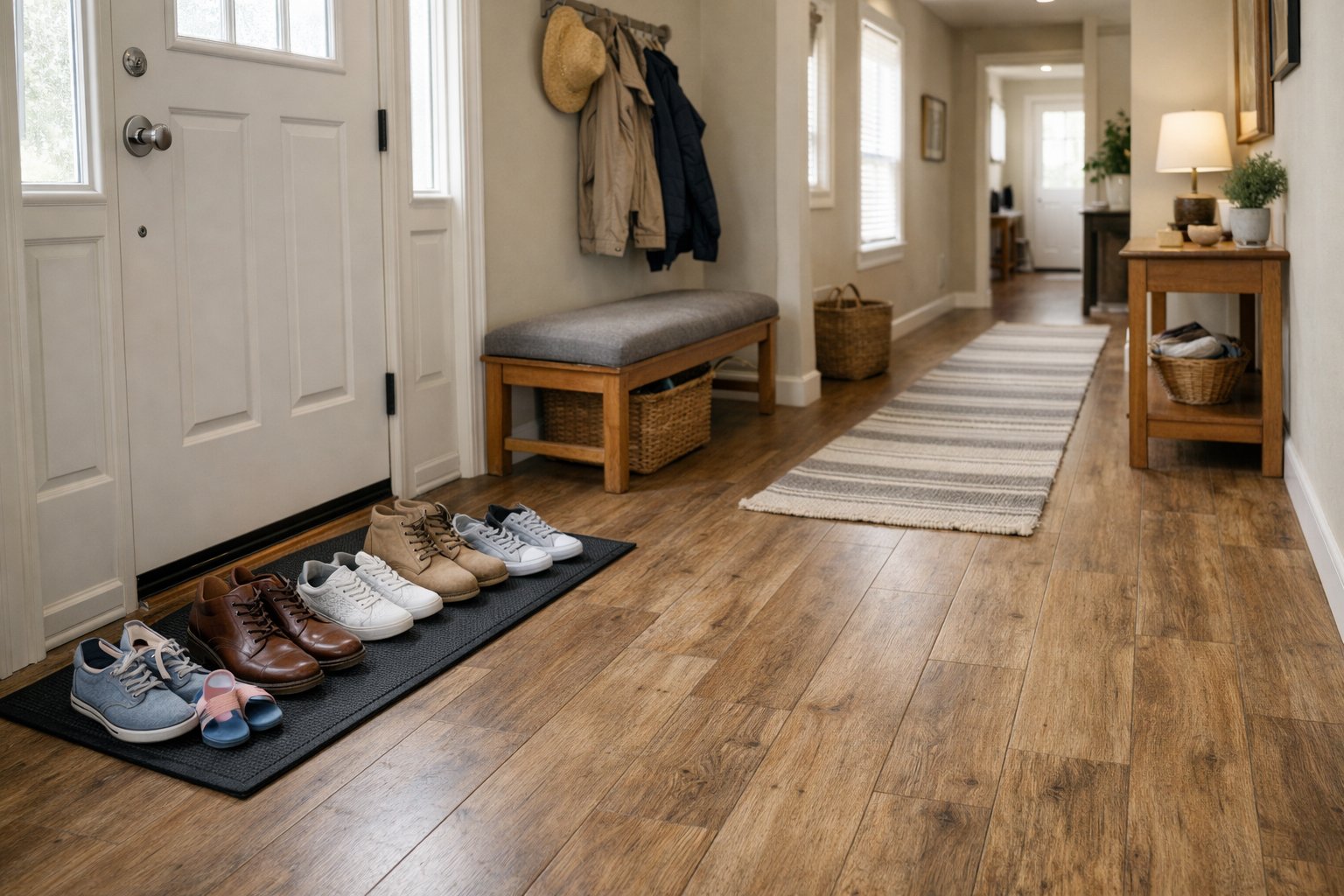
Laminate flooring has come a long way from the hollow, clicky planks many homeowners remember from years ago. Today’s laminate products look more realistic, feel sturdier underfoot, and rely heavily on advanced plank locking systems to perform well over time. One of the biggest real-world tests for these locking systems is how they handle imperfect subfloors. Very few homes have perfectly flat surfaces, especially in older Inland Empire houses or slab-on-grade construction common throughout Southern California.
Understanding how laminate plank locking systems respond to subfloor irregularities can make the difference between a floor that lasts for decades and one that starts separating far too soon.
Why subfloor flatness matters more than most realize
Laminate flooring is designed as a floating floor, meaning it is not nailed or glued directly to the subfloor. Instead, the planks lock together and move as a single surface. This design depends on consistent support underneath. When a subfloor has dips, humps, or gradual waves, the locking mechanism becomes the stress point. Over time, uneven support causes planks to flex, placing pressure on the joints rather than distributing weight evenly across the floor.
Homeowners exploring modern laminate flooring options are often surprised to learn that most manufacturers allow only very small deviations in subfloor flatness. Even slight irregularities can affect how well the locking system stays engaged.
A closer look at modern laminate locking systems
Most laminate floors today use variations of angle-angle, angle-tap, or fold-down locking systems. These designs allow planks to snap together securely without adhesives. High-quality systems are engineered with tight tolerances and reinforced joint edges to minimize movement. When installed over a reasonably flat subfloor, these locks create a strong, unified surface that can handle daily foot traffic, rolling furniture, and seasonal changes.
However, even the best locking systems have limits. They are designed to float, not bridge structural problems. Subfloor irregularities beyond manufacturer tolerances can cause joints to lift, separate, or click when walked on.
How minor subfloor imperfections are absorbed
Small variations in subfloor flatness are common and expected. Minor dips or shallow waves are often absorbed by the underlayment combined with the flexibility of the locking system. Quality underlayments help distribute weight and reduce point pressure on plank joints. This is why pairing laminate flooring with the right underlayment is just as important as choosing the plank itself.
Many homeowners assume thicker laminate planks automatically solve subfloor issues. While thickness can improve stability, it does not eliminate the need for proper surface preparation. Locking systems still rely on even support to perform as intended.
What happens when subfloor irregularities exceed tolerance
When irregularities become more pronounced, problems begin to show. High spots can prevent planks from fully engaging, weakening the lock. Low spots allow planks to flex downward when walked on, causing the joints to pull apart over time. This often leads to visible gaps, edge chipping, or a hollow sound underfoot.
In severe cases, repeated stress can cause locking systems to fail altogether. Once the joint integrity is compromised, repairs usually require plank replacement rather than simple adjustments. This is where professional flooring installation makes a measurable difference, as experienced installers correct these issues before planks ever lock together.
The role of installation techniques in lock performance
Proper installation plays a major role in how laminate locking systems respond to imperfect subfloors. Professional installers check flatness, identify problem areas, and correct them before planks are laid. Grinding down high spots, filling low areas, and selecting the right underlayment all help protect the locking mechanism long-term.
Expansion gaps, plank orientation, and layout planning also matter. Poor spacing or rushed installation can compound subfloor issues, putting additional strain on plank joints even when the surface below is relatively level.
Why some laminate products perform better than others
Not all laminate locking systems are created equal. Premium products often feature reinforced joint profiles, moisture-resistant cores, and precision-milled edges that tolerate minor subfloor movement better than entry-level options. Choosing a laminate product based solely on appearance can lead to performance issues if the locking system is not suited for the home’s conditions.
Matching the product’s locking design to the subfloor realities of the home is one of the most overlooked steps in successful laminate installations.
Long-term durability starts below the surface
Laminate floors that perform well over time usually share one thing in common: careful attention to subfloor preparation. Locking systems are incredibly strong when supported properly, but they are not designed to compensate for structural flaws. Addressing irregularities before installation protects the joints, maintains a smooth walking surface, and preserves the floor’s appearance year after year.
Many post-installation complaints trace back to subfloor conditions that were never corrected, not product defects. Preparation is what keeps locking systems working as designed.
Ready to schedule laminate flooring installation?
For help selecting laminate flooring and ensuring it is installed over a properly prepared subfloor, reach out to our flooring experts at Wally’s Carpet & Tile. With locations in San Bernardino, Yucaipa, and Upland, plus convenient shop-at-home services, scheduling a consultation through the contact us page is the first step toward a floor that performs the way it should.


